Oil sands operators are seeking Fisheries Act tailings permits to discharge tailings into the Athabasca and Mackenzie watersheds
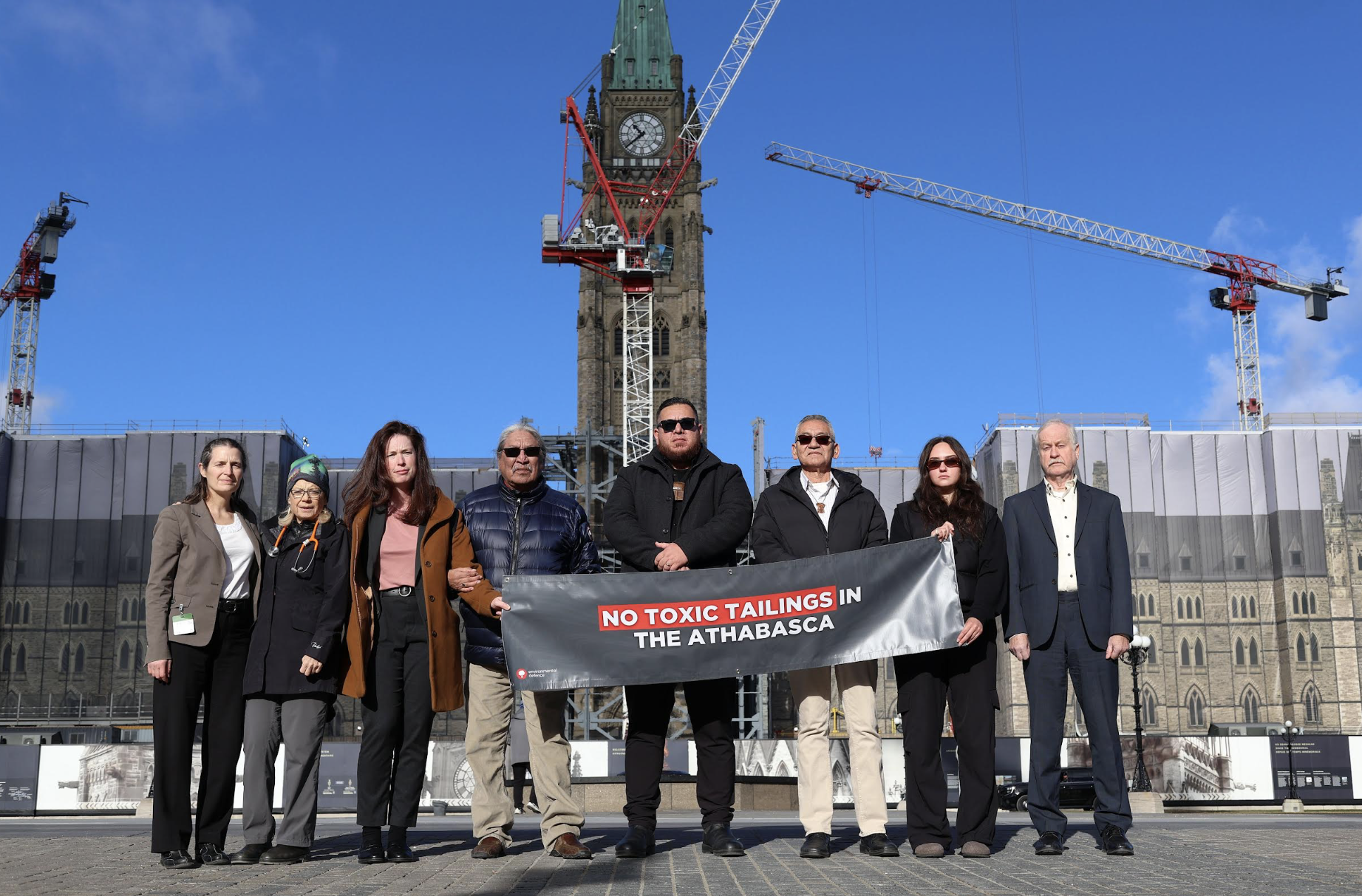
Ottawa | Traditional, unceded territory of the Algonquin Anishinaabeg People – Representatives of First Nations downstream from the oil sands brought a clear message to the federal government today: protect northern waters from any plan to release oil sands tailings.
The federal government may fast-track industry-driven tailings permits under the Fisheries Act. Such a move would go against the wishes of the downstream First Nations and the Dene Nation. It would also override the concerns of the Government of the Northwest Territories, farther downstream along the Mackenzie River and out to the Beaufort Sea.
First Nations downstream from the oil sands have opposed the release of tailings for decades. These permits threaten their waters, their treaty rights and their health.
A fast-tracked Fisheries Act permit could allow the release of billions of litres of effluent per day, putting the human and environmental health of the entire watershed at risk.
Federal investments that facilitate oil sands expansion add to those risks. Expansion has major implications for the climate, and would add millions more litres of toxic tailings to the landscape.
First Nations and their allies say the risks their communities face, the concerns about release permits and the need for health-protective federal tailings regulations should be addressed through the risk assessment and management process under the Canadian Environmental Protection Act instead.
Quotes:
Mike Mercredi, Councillor, Athabasca Chipewyan First Nation:
“Downstream Nations say no to tailings releases into our waters. In whose national interest are these federal dollars flowing into expanding the tailings crisis?”
Gerry Cheezie, Dene Nation:
“This is federally-funded tailings, being created to fill a pipeline we’re paying for with public dollars.”
Jesse Stoeppler, Gitxsan:
“This is yet another federal example of decision-based evidence-making—and science, Indigenous people, our health and the planet are bulldozed to the benefit of foreign companies.”
Cassie Barker, Environmental Defence:
“Polluters can’t be allowed to write the rules for their own industrial projects, and we cannot accept sacrifice zones in the name of the national interest. A Canada worth defending protects the people and ecosystems downstream.”
Paul Belanger, Keepers of the Water:
“We cannot trust oil sands data reported by the Alberta Energy Regulator. The AER simply shares water usage and spillage information as reported by the oil companies. This information is unverified but is currently accepted as fact by our governments. There are several oil sand data issues. For example, incomplete environmental monitoring leaves us with a poor understanding of cumulative impacts around and downstream of the oilsands regions. Indigenous communities need accurate information and the Alberta Government push for increased bitumen production could lead to ecocide.”
Dr. Suzanne Perkins, Canadian Association of Physicians for the Environment:
“Safe water is foundational to human health. Releasing billions of litres of tailings wastewater into the Mackenzie watershed would endanger the health of entire communities across the Northwest Territories for generations to come. It is unconscionable that the federal government would consider putting the health of northern First Nations at risk to solve the oil industry’s toxic waste problem. No community should have to sacrifice its health for industry profits.”
Lisa Gue, David Suzuki Foundation:
"Despite what fossil fuel lobbyists want you to think, the evidence is clear: Canadian oil and gas is not clean. Our dependence on fossil fuels is not only creating a climate crisis, but also a contamination crisis due to the toxic tailings from oil sands production. This will only worsen if it increases to fill the proposed Pacific Link pipeline. Canada's new National Strategy on Environmental Racism and Environmental Justice says that environmental protection should be guided by best-available science and Indigenous Knowledge Systems, and grounded in a clear understanding of disproportionate harms experienced by impacted communities. The government must stand by this strategy and address community concerns about toxic tailings instead of pursuing oilsands expansion."
Background:
More than 1.4 trillion litres of toxic oil sands tailings have accumulated over decades, sitting as close as 5 km from the Athabasca River — with no industry accountability for leaks, no remediation plan, and Premier Smith pushing to double bitumen production.
The Fisheries Act only permits a treat-and-release approach, while CEPA allows for a broader range of protections — including treatment, reuse, leak detection, and only limited, conditional release — better reflecting the needs of downstream Indigenous Nations.
The Canadian Environmental Protection Act (CEPA) offers the right framework. Under CEPA, Ministers of Environment and Health are assessing whether oil sands process-affected water (OSPW), including naphthenic acids, is toxic. If deemed toxic, risk management measures must prioritize pollution prevention, uphold Indigenous rights and UNDRIP, and protect vulnerable populations.
These include requiring industry to treat tailings using best available technologies, mandating reuse to reduce volume, requiring leak prevention and repair on prescribed timelines, establishing a cleanup security deposit system, and restricting tailings production under specified conditions.
All regulatory tools should be prioritized in accordance with the rights and interests of downstream Indigenous Nations — consistent with CEPA's commitments to UNDRIP — ensuring communities are not forced to absorb further harm from what the backgrounder calls a "toxic chemical soup."
ABOUT ENVIRONMENTAL DEFENCE (environmentaldefence.ca): Environmental Defence is a leading Canadian environmental advocacy organization that works with government, industry and individuals to defend clean water, a safe climate and healthy communities.
ABOUT KEEPERS OF THE WATER (keepersofthewater.ca): Keepers of the Water is an Indigenous-led environmental advocacy organization dedicated to protecting water, lands and watersheds through Indigenous sovereignty, Treaty rights, Traditional Ecological Knowledge, scientific research, education and community advocacy to ensure clean and healthy water for present and future generations.
– 30 –
For more information or to request an interview, please contact:
Carolyn Townend, Environmental Defence
Talon Giroux, Keepers of the Water
Communications@keepersofthewater.ca 587-921-3574